Thèse Technologies Avancées de Combustion sans Flamme pour l'Ammoniac et les Mélanges Ammoniac-Hydrogène dans un Four Semi-Industriel H/F
Doctorat.Gouv.Fr
- Paris - 75
- CDD
- Bac +5
- Service public d'état
Les compétences pour ce job
- Habilitation électrique H2
- Diagnostic technique
Les missions du poste
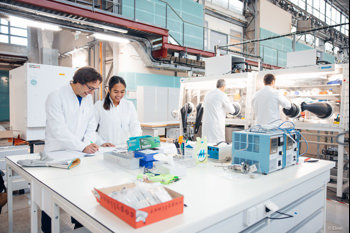
Ce projet étudie la combustion sans flamme, ou dite MILD (Moderate or Intense Low-oxygen Dilution), de mélanges ammoniac (NH)/hydrogène (H) afin de décarboner les procédés de chauffage industriel. Il vise à surmonter les limites de l'ammoniac, notamment sa faible réactivité et sa forte propension à former des NO, en exploitant les conditions de forte dilution et de préchauffage caractéristiques de la combustion MILD. Des expériences menées sur un four semi-industriel permettront de caractériser l'allumage, la structure de la flamme, les champs de température et les émissions, tout en validant des mécanismes cinétiques détaillés. Le projet produira une base de données expérimentale de référence, contribuera à l'amélioration des modèles prédictifs de combustion et établira des recommandations pour l'intégration de mélanges NH/H dans les installations industrielles existantes. Climate change and energy security are driving an urgent transition away from fossil fuels. Yet, many industrial and transport applications still rely on combustion due to their need for high energy densities and thermal processes. Electrofuels (e-fuels), produced from renewable electricity and sustainable feedstocks, represent a promising solution, enabling deep decarbonization.
DESIRE is a Marie Skłodowska-Curie Doctoral Network aiming to train 15 PhD researchers in the efficient and clean use of renewable synthetic fuels. Candidates will develop advanced skills in combustion science, chemical kinetics, and digital modeling. Each PhD will lead to a double degree awarded by two partner universities, preparing graduates to become leaders in Europe's energy transition.
This research addresses the decarbonization of industrial heating by investigating MILD (Moderate or Intense Low-oxygen Dilution) combustion using ammonia (NH3) and hydrogen (H2) blends. While ammonia is a carbon-free energy carrier, its implementation is difficult because of its low reactivity and high NOx potential. This research aims to overcome these hurdles by leveraging the high-dilution, high-temperature preheating characteristics of MILD combustion to achieve stable, low-emission operation in semi-industrial furnace environments. 1. Mixing and Ignition dynamics - characterize fuel air mixing and ignition behavior of NH3/H2 blends under MILD conditions
2. Experimental techniques - use of suitable optical diagnostic techniques to map flame structure and differentiate zones inside the setup
3. Kinetic validation - measuring fundamental kinetic parameters for different compositions
4. Evaluation of the feasibility for the application of these insights in industrial furnace operation.
Operational limits - Primary work will be conducted using the semi-industrial furnace at ULB. Here, the main objective is to map transitional boundaries between stable flame and MILD regimes by varying different properties.
Temperature and emission profiles - collecting the data on temperature distribution and emissions using analyzers, pyrometers. More focus will be on the transition regime using different possible optical techniques.
Le profil recherché
Bienvenue chez Doctorat.Gouv.Fr
Publiée le 02/07/2026 - Réf : c2baeefe5f22d39f54a9f081297399e0